
StoryPages vs GoHighLevel: an honest side-by-side from a former reseller
We resold GoHighLevel to hundreds of clients before building StoryPages. Here is where GHL genuinely wins, where it loses, and how to tell which one you actually need.
Most comparison articles are written by people who have never seriously used the competitor. This one is not.
James Cook Media spent years as a substantial GoHighLevel reseller. We put hundreds of clients on it — authors, coaches, consultants, local service businesses. We built their sites, wired their funnels, configured their automations, and then answered their support calls. That experience is exactly why StoryPages exists.
So this is not a hatchet job. GoHighLevel is genuinely powerful software. But we learned something expensive over those years, and it is the entire thesis of our product:
The bottleneck was never the software’s capability. It was that the person who owned the business could never operate it without us.
The short version
If you are an agency that wants to resell a white-labelled marketing platform under your own brand, with phone systems and SMS and a marketplace of prebuilt snapshots, GoHighLevel is still the more complete answer today.
If you are the person whose name is on the business — an author, a coach, a consultant, a local operator — and you want a professional website plus the CRM and email underneath it, without becoming an administrator of a marketing platform, that is what we built StoryPages for.
Where the two products actually differ
Here is the honest matrix. Note the nuance column — a table claiming the competitor does nothing is marketing, not analysis.
| Capability | StoryPages | GoHighLevel |
|---|---|---|
| Build a website by describing it GHL has AI assists inside a builder; the build path is still a builder. | ✓ | — |
| Approve style, sitemap, and wireframes before content | ✓ | — |
| Usable day-to-day by a non-technical owner In our experience most GHL accounts are run by an agency or VA. | ✓ | Rarely |
| AI visibility shipped by default llms.txt, structured data, semantic HTML, static delivery. | ✓ | — |
| CRM included | ✓ | ✓ |
| Email marketing included | ✓ | ✓ |
| Funnel builder | ✓ | ✓ |
| MCP server for Claude and ChatGPT | ✓ | — |
| Phone system, SMS, and dialer A genuine GHL strength we do not match. | — | ✓ |
| White-label SaaS reselling GHL is built for this; we are not, yet. | — | ✓ |
| Third-party snapshot marketplace | — | ✓ |
| Entry price | $29/mo | $97/mo |
Read that table honestly and you can see the shape of the decision. It is not “which one has more features”. It is who is going to sit in the chair.
The setup experience is the whole argument
Ask anyone who has onboarded onto GoHighLevel what the first week felt like. The vocabulary alone is a project: sub-accounts, snapshots, triggers, workflows, pipelines, custom values. Every one of those concepts is legitimate. Together they are a platform you administer.
Here is what starting on StoryPages looks like instead. You type what your business is:
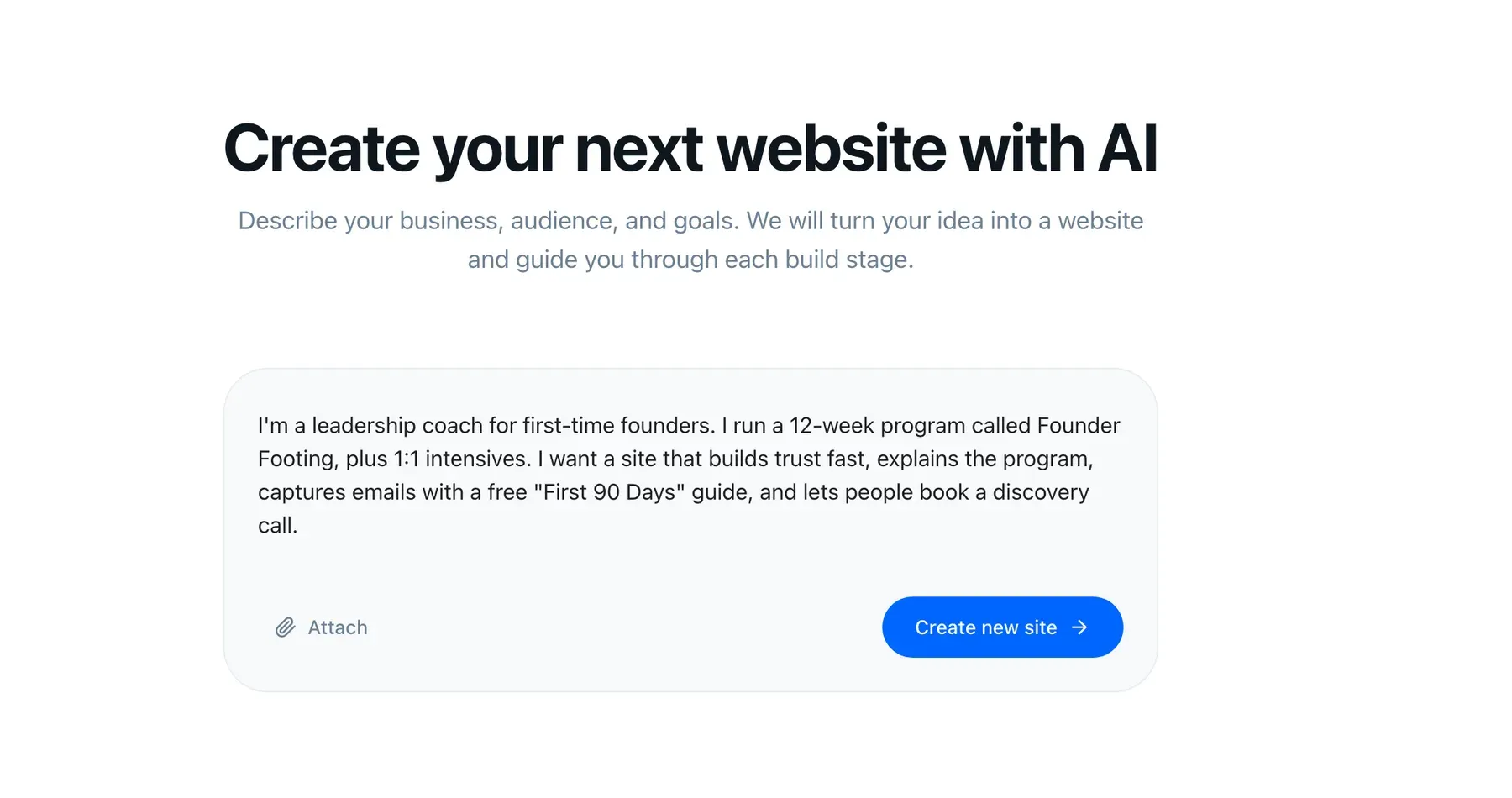
Then you approve four things — the style, the sitemap, the wireframes, and the final build — and the site is live. The AI assistant stays in the left rail afterwards, so changing the site later is a sentence rather than a ticket:
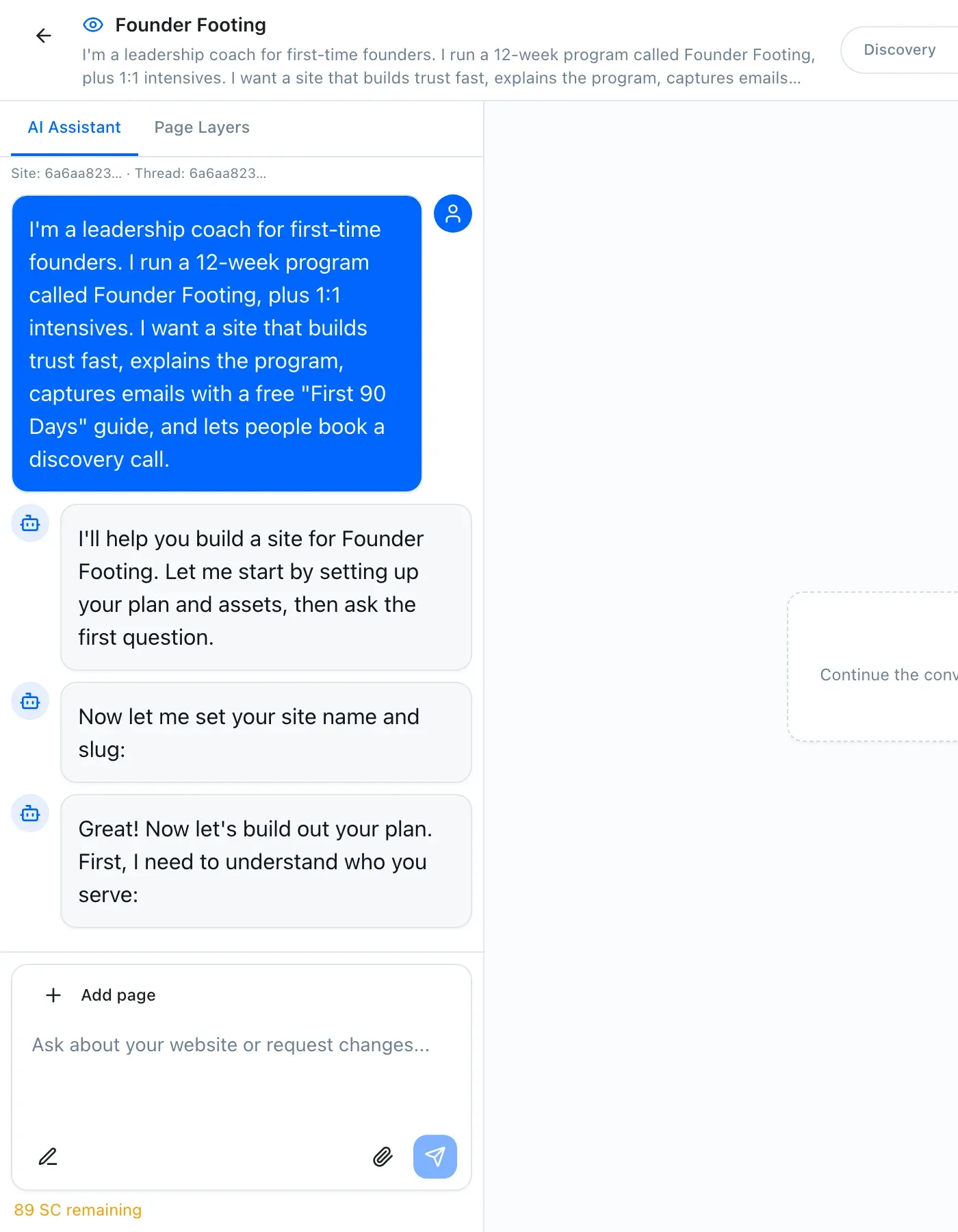
This difference sounds cosmetic. It is not. It decides whether the website gets updated in month four, or quietly rots because updating it means booking time with somebody.
The thing neither of us was doing five years ago
There is one axis where the comparison is not close, and it is the one that changed most recently.
Your buyers increasingly do not start at Google. They ask ChatGPT for a
recommendation, or they read Google’s AI Overview and never scroll. Those systems
can only surface you if your site is machine-legible: real structured data,
clean semantic markup, fast delivery, and increasingly an llms.txt file that
tells a model what your site is and where the important pages are.
On GoHighLevel, that work is yours. Possible, but yours — or your agency’s.
On StoryPages it is a default. Every site ships schema, llms.txt, semantic
HTML, and static pages, because we think in two years a site without them will
look the way a site without a mobile layout looked in 2014.
We hold ourselves to it too: the page you are reading publishes its own llms.txt and full structured data.
What GoHighLevel does better
I would not trust this article if it did not have this section.
Phone, SMS, and the dialer. GHL’s communications stack is real and we do not have an equivalent. If your business runs on outbound calling and SMS follow-up, that is a genuine reason to choose GHL.
White-label reselling. GHL is architected so an agency can resell it as their own SaaS. If that is your business model, we are not currently the tool.
The snapshot ecosystem. Years of third-party snapshots and templates mean you can often import a whole vertical’s setup in one action.
Maturity in the long tail. GHL has been hardened by an enormous user base. There are edge cases it handles that we have not met yet.
If two or more of those matter to you, choose GoHighLevel. I would rather you read this and pick correctly than sign up, discover the gap, and churn.
Where the money actually goes
The sticker comparison is $29 against $97. That understates the difference, in both directions.
GoHighLevel’s $97 buys a genuinely larger surface area of features. But the real cost of a GHL setup, in every engagement we ran, included one of:
- an agency retainer to build and maintain it,
- a contractor or VA to operate it, or
- a meaningful number of the owner’s own hours, indefinitely.
That was our business for years. I am describing our own invoices.
StoryPages plans differ by number of sites, pages per site, and CRM contacts — so a solo consultant and a ten-client agency pay different amounts, but neither pays a specialist to keep it running. See the plans.
How to decide in five minutes
Answer these:
- Who will log in most weeks? If the answer is you, and you are not technical, that points to StoryPages. If it is an agency or an operator you employ, GHL is viable.
- Do you need outbound phone and SMS? If yes, GHL.
- Are you reselling the platform to your own clients as your product? If yes, GHL.
- Do you care whether ChatGPT can recommend you? If yes, StoryPages does it by default; on GHL, budget the work.
- How fast do you need to be live? StoryPages is a same-day path. A considered GHL build is weeks.
The honest summary
GoHighLevel won its market fairly, and for agencies it is still a strong answer. We sold it, we made money with it, and we would not tell you it is bad software.
But we watched hundreds of capable business owners fail to operate it, and we stopped believing that was their fault. StoryPages is the product we wanted to hand those people: describe your business, approve a plan, get a real website — with the CRM, email, and funnels attached, and AI visibility already handled.
If you were us five years ago, you would have built the same thing.