
StoryPages, StoryOS, and StoryFunnels: how the pieces fit
How StoryPages, StoryOS, and StoryFunnels divide the work — public site and front office, internal work OS, and done-with-you funnels.
Three products with the same prefix invites a fair question: is this a suite, or is it three things a company happened to build?
It is neither, exactly. It is one observation split across three shapes.
Over years of building 300+ client websites and funnels, we kept meeting the same business with the same three unmet needs, and they were never the same need. A consultant needed a public site that would keep working without us. She also needed somewhere to run the actual work — clients, engagements, deliverables — that was not a spreadsheet. And sometimes what she wanted was not software at all but a person to build the launch with her.
Most software suites are one product with three price tiers. These are three products because the jobs do not overlap: your public face, your internal machine, and the human help.
Here is the division of labour, and — more usefully — what each one is not.
StoryPages: your public face and the front office attached to it
StoryPages is an AI website builder with the marketing front office built in.
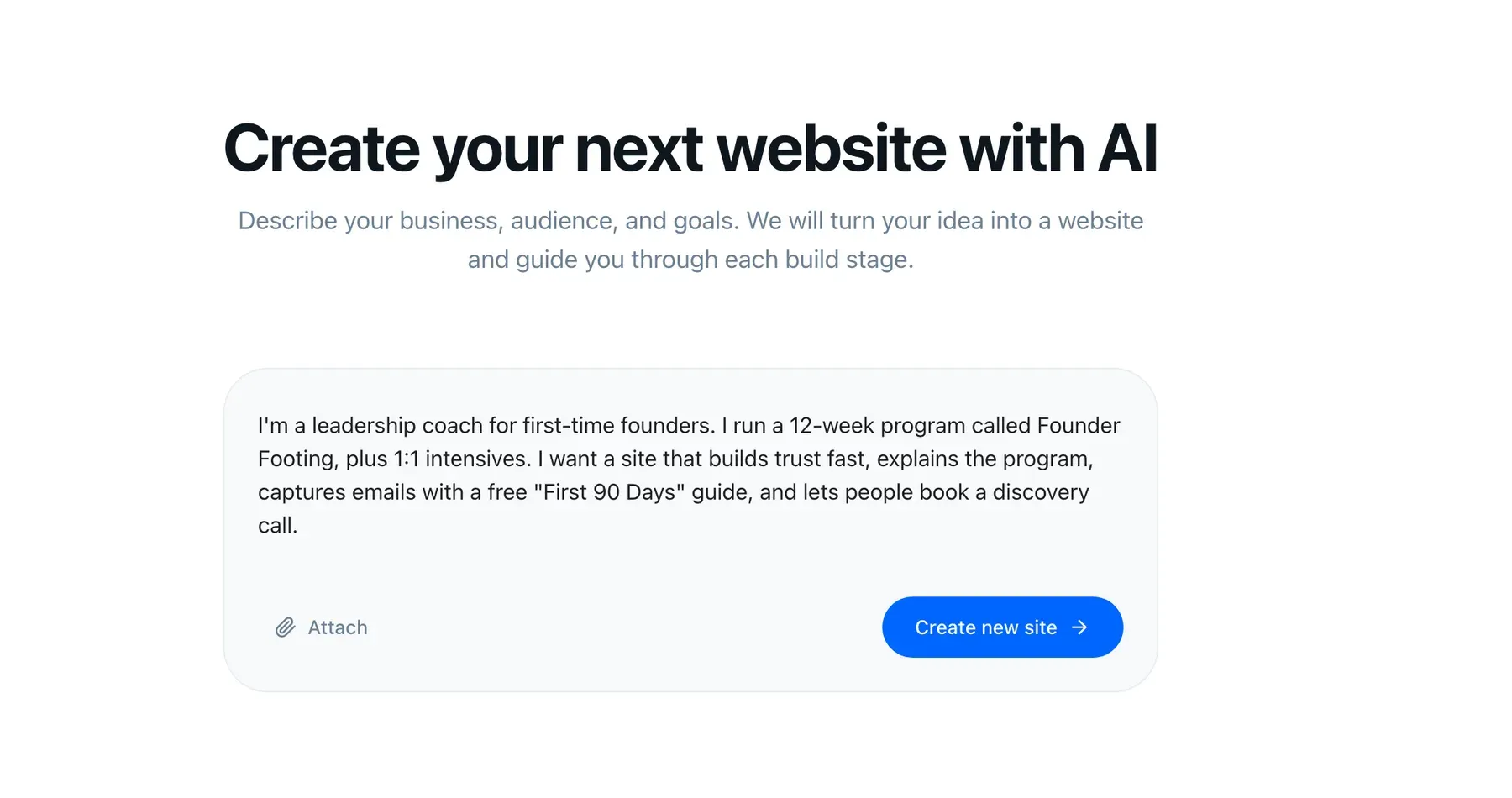
The build path is a conversation: you describe your business, approve a style direction, approve a sitemap, approve wireframes, and the site goes live. Then you keep editing by talking to it.
Attached to the site, in the same product: a CRM, email marketing, a funnel builder, and hosting with domains and SSL. Webinars and calendar booking are on the roadmap — not shipped, and I am not going to pretend otherwise.
The differentiator we care most about is AI visibility,
on by default. Structured data, llms.txt, semantic HTML, fast static pages —
because a growing share of your buyers ask an assistant for a recommendation
before they ever see a search results page.
StoryPages is not an internal operations tool. It does not model your delivery process, your project pipeline, or your custom business objects. If you find yourself trying to bend the contact record into a project tracker, you have reached the edge of the product and the answer is the next section.
StoryOS: where the business is actually run
StoryOS is an API-first work OS, and it is open source — AGPL-3.0, self-hostable if you want it on your own infrastructure.
The core idea is that you define the data model. Not “projects and tasks” as handed down by a vendor, but the relational databases your business actually has: engagements linked to clients linked to deliverables linked to invoices, with the fields and relations you decide on. Eight view types sit on top of that data — the same records shown as a table, a board, a calendar, and so on — plus automations for the work that should happen without you.
It also ships a native MCP server, which matters more than it sounds. It means an AI assistant can query and modify your operational data directly, as a first-class capability rather than a scraped API bolted on afterwards.
Pricing is a free plan, $29 per workspace for Pro, and $99 per workspace for Business — per workspace rather than per seat, with no record limits ever, and viewers and commenters always free. That pricing shape is deliberate: it means inviting your whole team to look at things costs nothing, which is how internal tools actually get adopted.
StoryOS is not a website builder. It has no page builder, no themes, no marketing email, no public-facing site to speak of. It is also not a preconfigured CRM — it can model one very well, but it hands you a capable blank system rather than an opinionated marketing pipeline. If you want contacts, tags, and broadcast email working this afternoon, that is StoryPages.
StoryFunnels: the practice, not a product
StoryFunnels is the story-driven funnel work and the agency services — done with you rather than sold to you as software.
Some people do not want a tool. They want the launch to exist, they want someone with pattern recognition to argue with them about the offer, and they want the narrative to be right before anything gets built. That is a service, and pretending it is a SaaS feature has never worked for anyone.
It is also worth saying that this practice is where the products came from. The reason StoryPages has opinions about sitemaps and story order is that we built hundreds of funnels by hand first and learned which sequences work.
StoryFunnels is not self-serve, and it is not the cheap option. If your budget is a monthly subscription, start with the software.
Which one you need, in one pass
Pick the first that describes you.
- “I need a professional website, and a list I can actually email.” → StoryPages. See the plans.
- “My website is fine; my problem is that the work runs on twelve spreadsheets.” → StoryOS.
- “I need both, and I know it.” → Start with the one that is bleeding. In our experience that is usually the website, because it is the one your buyers see.
- “I want it built with me, by people who have done it before.” → StoryFunnels.
- “I want to self-host and own my data outright.” → StoryOS. It is the only one of the three that is open source.
Notice that four of those five answers are one product. That is intentional. We are not trying to sell you a suite.
The connective tissue, described honestly
This is the section where most ecosystem articles overclaim, so let me be precise about what does and does not exist.
What exists: both StoryPages and StoryOS expose MCP servers, and both have APIs. That combination is genuinely useful. An AI assistant connected to both can read your public site structure and your internal operational data in the same session — “which of the clients in my delivery database came in through the consulting page, and what did we last ship them” spans both systems and is answerable without a single export.
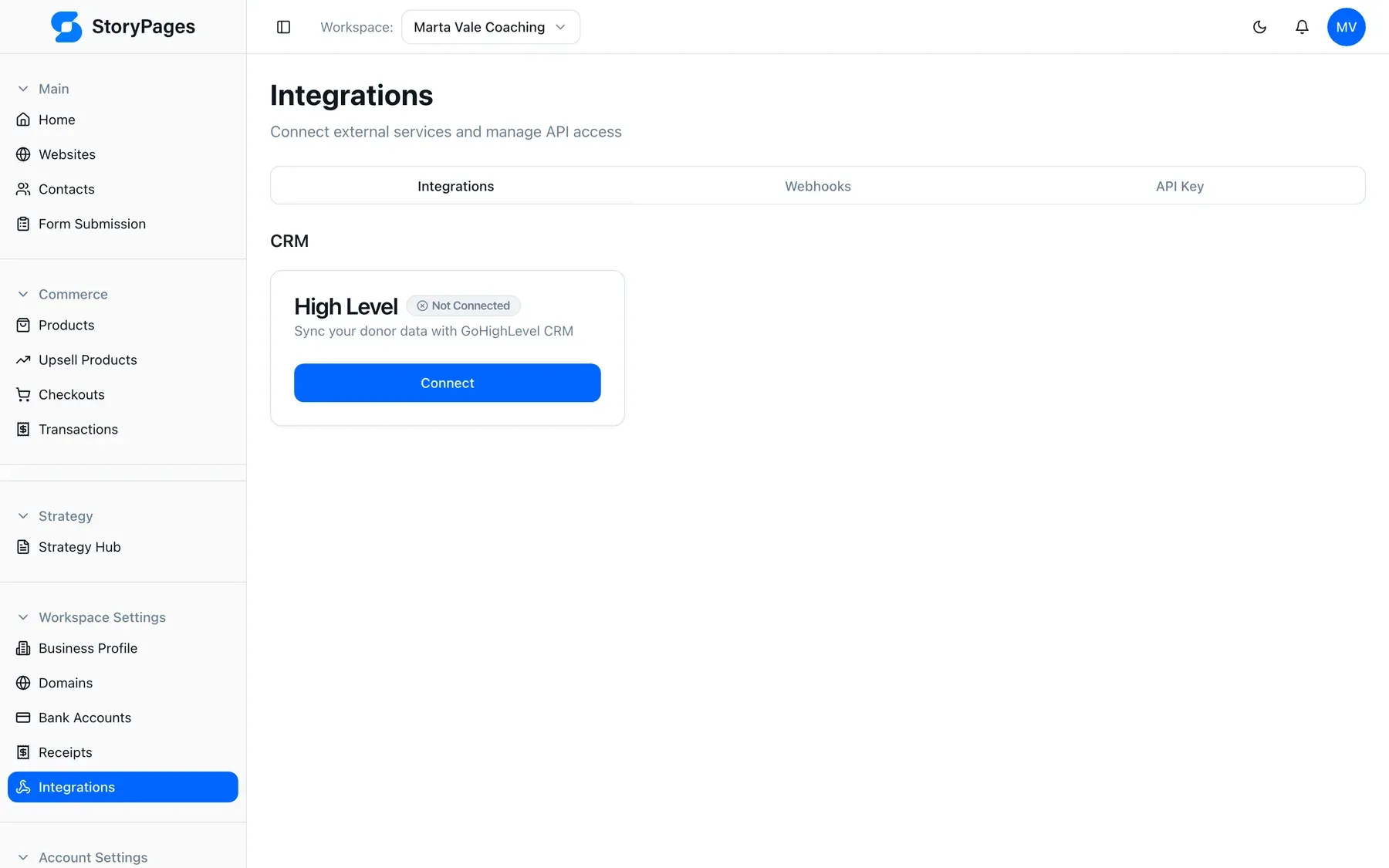
What does not exist: a deep prebuilt two-way sync between StoryPages and StoryOS. There is no toggle that mirrors your CRM contacts into a StoryOS database. If you want a form submission on your site to create a record in your internal system, you build that with the API or an automation. It is a normal amount of work for a technical person and a real amount of work for a non-technical one.
We would rather you know that now than discover it after signing up for both. More on the current surface at integrations and the MCP server.
Why we did not merge them
The obvious product-strategy question: why three logins instead of one?
Because the data models have almost nothing in common. A website builder needs pages, sections, themes, sitemaps, and a contact record shaped for marketing. A work OS needs user-defined schemas, arbitrary relations, views, and permissions shaped for internal collaboration. Merging them produces a tool that does marketing badly and operations badly, which is a description of several products you have probably tried.
They also change at different speeds and serve different buyers. StoryPages serves a non-technical owner who wants the thing done. StoryOS serves someone who wants to model their own business precisely, including developers, including people who will read the source. Those are not the same person and they should not be forced into the same onboarding.
The thing they share is a bet: that AI assistants are becoming a primary interface to software, and that the products which expose themselves properly to those assistants — through MCP, through clean APIs, through machine-legible public pages — will be the ones worth using in three years. That bet is why both products shipped MCP servers early, and why every StoryPages site ships AI visibility by default.
The short version
StoryPages is your public face and the front office attached to it: website, CRM, email, funnels, AI visibility. Hosted, non-technical, see how it works.
StoryOS is the internal machine: user-defined relational databases, eight view types, automations, native MCP. Open source, self-hostable, storyos.dev.
StoryFunnels is the human help: story-driven funnels built with you. storyfunnels.ai.
Pick one. Add another only when you can name the specific thing it fixes.